
This intervention (which is suggestive, as what unfolds does not constitute a formal argument) explores the concept of leadership through the prism of intention and virtue, particularly as they relate to Asian-Australian contributions to the cultural sector. To begin, I’d like to describe a historical event that often goes unrecognized, involving a significant ethical question from the past century. In 1956, Oxford University proposed awarding an honorary degree to former President Harry S. Truman, known for his decision to order the atomic bombings of Hiroshima and Nagasaki during World War II. The dissent against this honor notably came from philosopher G.E.M. Anscombe and her colleague, Phillippa Foot, who argued that Truman’s actions amounted to mass murder and were thus comparable to honoring figures such as Hitler or Nero. They contended that the mere foresight of catastrophic loss does not absolve one of the ethical implications associated with the intention behind mass killing, and that the means to an end (in this case, ending World War II) are actions within one’s intention[1].
This acute case, which centers on the notion of intention, serves as an entry point for rethinking the philosophical implications of (Asian-Australian) leadership. However, we must first consider the contexts of intended actions in leadership—are they confined within legal and constitutional frameworks, cultural citizenship, or the evolving conceptualization of diaspora[2]? Each of these areas influences the dynamics of leadership distinctions, but a detailed description of these dynamics would go well beyond the scope of this intervention.
Suffice it to say, there is a need to consider the types of leadership intentions and the considerations by the agents of leadership in these three unique contexts. Leadership in a multicultural setting, particularly today, challenges traditional notions of allegiance to national identities. A focus on cultural citizenship encourages the integration of diverse values from diasporic communities, ultimately enriching the dominant culture and, hopefully, broadening the national narrative. Cultural citizenship enables participation and belonging at various governmental levels, allowing for a more inclusive and participatory society[3].
Returning then to the core of Anscombe’s dissent invites deeper philosophical inquiries into ethics. It represents a shift from a purely functionalist outlook that rationalizes war through ends justifying means, toward a more ethically grounded assessment that scrutinizes intentions. This shift is critical when assessing leadership in cultural citizenship, which espouses empathy within diversity and values the virtues associated with diverse leadership styles and cultural ontologies.
The values inherent in leadership action may indeed be indistinguishable from our virtues, or they may involve our capacity to admire, discern, and form friendships with others whose acts and intentions are virtuous. Leadership and actions within the realm of cultural citizenship are no different. This intervention, then, invites us to look at leadership through the lens of cultural citizenship, empathy in heterogeneity, intention, and virtues. By considering some of the following historical examples of leadership through intention and virtue, particularly from Asian-Australian cultural agents, we may be informed to consider fresh alternatives for conceptualizing leadership—not through the lens of nationalism, representation, fixed identities, or pragmatically functionalist, rule-bound, or results-based parameters of the past.
The historical deeds of Lowe Kong Meng, Alice Lim Kee, and Daisy Kwok illustrate varied dimensions and instances of Asian-Australian leadership. While Lowe Kong Meng (Liu Guangming 劉光明, 1831-1888), a Chinese-Malaysian merchant, had a prominent impact on the Victorian goldfields and found success within the colonial era, it is essential to recognize that he lived before Australia’s Federation in 1901. Labeling him as an Asian-Australian requires context, as he was more a citizen of a colonial world than of a nation-state. Despite this, his contributions, which may require an intersectional qualification, set a significant precedent for virtuous, intentional leadership and cultural participation in Australia.
Lowe arrived in Victoria to pursue opportunities during the gold rush, ultimately becoming a respected figure in politics and philanthropy. His recorded efforts, such as his involvement in defending the Anglo-Chinese Peking Convention of 1860, which gave reciprocal rights for the Chinese to travel and work in the British Empire, were significant. While the Chinese were subjected to targeted taxation, discrimination, and violence, Lowe, in 1879, together with Louis Ah Mouy and Cheong Cheok Hong, published The Chinese Question in Australia. Although rhetorically filled with pride and at times sarcasm, it remains a leading document advocating for the legal rights and opportunities of the Chinese in Australia, implicitly demonstrating the importance of both intention and virtue in leadership advocacy. Lowe, incidentally, also died young at 57, yet became one of the wealthiest men in Victoria, leaving behind a philanthropic footprint, including remarkable buildings in Melbourne’s Chinatown and the realization of the first bilingual one-pound note with the Commercial Bank of Australia.
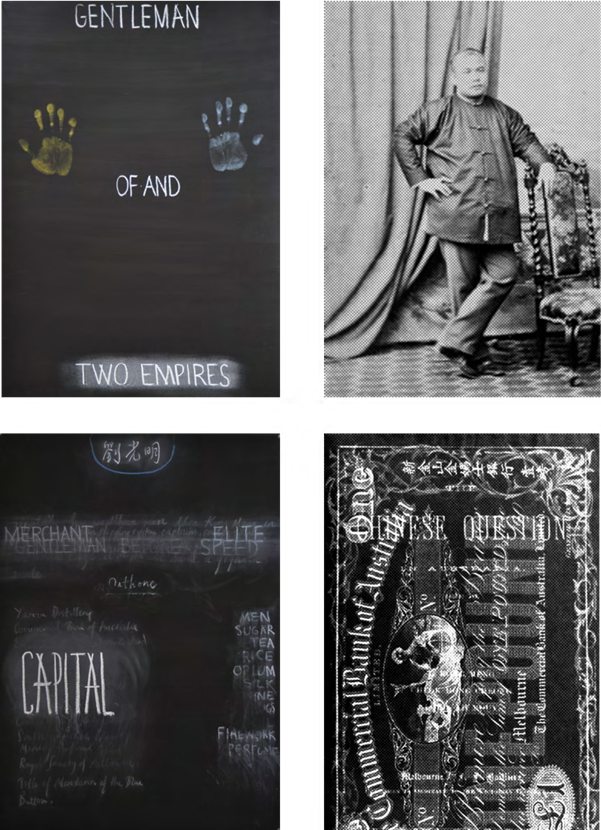
Without any reimagining of Lowe’s history, we can see that he was an Asian participant in colonial Australia exercising leadership in certain deeds with bi-culturalism. Another revealing event that demonstrates his intentions occurred when Redmond Barry invited Lowe to curate Chinese art for an exhibition in 1869. Lowe declined the invitation, citing the poor quality of art available in Victoria. In many ways, Lowe’s leadership—demonstrated through cultural discernment, scholarship, and cosmopolitanism—was appreciated by the white public prior to Federation. This forfeiting of an opportunity reveals that Lowe was not merely interested in participation, occupation, or agency; there was a qualitative impulse behind such refusal that indeed involved intention and virtue.
Yet, post-Federation, with Lowe’s death and the advent of the national White Australia Policy, even basic opportunities for the Chinese in Australia ceased. While leadership opportunities were denied, the very right to national allegiance was also revoked. For example, Lowe’s Eurasian son, George, was refused enlistment to fight in the First World War for Australia on the grounds that he was “not substantially of European origin.” This provides a clear example of the challenges faced in the early years of Australia’s Federation (and the difficult birth of the term “Asian-Australian”). Not only was a sense of leadership and participation denied, but so too was one’s very intention for action—one’s request for agency in virtuously defending one’s country. Within the national policy of White Australia, such an act was considered an implication of treason.
Similarly, Alice Lim Kee (Wu Ai-lien 伍愛蓮, born 1900 in Rutherglen, Victoria, died unknown date and place) and Daisy Kwok (born 1908 in Sydney, died 1998 in Shanghai) both experienced the restrictive effects of the White Australia Policy, yet represent the dynamic ways individuals adapt and assert leadership amidst societal constraints. It is from these perspectives that Asian-Australians born post-Federation may have felt compelled to place their efforts elsewhere. In the case of Alice Lim Kee and Daisy Kwok, that “elsewhere” was Shanghai. Much of their capacity and intention for leadership in ushering in new social practices—media, fashion, retail, and modernist politics, including feminist ideals—could not have been realized in Australia at the time. Yet through nascent research today, indications of their leadership deeds through virtuous intention are emerging.


The women migrated to Shanghai at the height of interwar modernity, rising to prominent positions in Shanghai society prior to the Japanese invasion and occupation in 1937. Alice became an actress and the first female radio announcer in Shanghai’s media industry, later working as a journalist for the English-language Shanghai North-China Daily News and becoming an ardent feminist. Daisy, through her family’s ties to the luxurious Wing On Department Store (which introduced the concept of department stores to China), was part of Shanghai’s vanguard elite. She was one of the first women in Shanghai to own and drive her own car, and she established the first East-West fashion house. Daisy Kwok chose to remain in Shanghai. Following persecution during the Communist takeover in 1949, she became a Chinese-Australian historian, assisting the Australian consulate when it reopened in Shanghai in 1987 by translating documents, teaching English, and preserving a longer history of China-Australia relations prior to the severing of diplomatic ties in the 1950s. She died in Shanghai in 1998 as an Australian citizen[4].
Alice Lim Kee escaped the occupation and traveled back to Australia before moving to America, where she spent many years advocating for and fundraising for Chinese refugees during the war, including traveling back to Australia to seek aid. What is also notable regarding Alice Lim Kee’s leadership deeds is her ability to work with multiple identities—Alice Lim Kee, Wu Ai-lien, ‘Little Miss Shanghai,’ and Mrs. Fabian Chow—depending on the context of her work. This dexterity with identities is not surprising for diasporic individuals. A diasporic individual’s necessary adaptability as they navigate different heterogeneous contexts also reflects the limits of possibilities and obstacles within leadership. For the purpose of this intervention, I suggest that leadership through deeds within such heterogeneous contexts relies ultimately on action-intention and virtue, as well as a capacity for achieving agency in any given context. Here, we see a level of dexterity in leadership beyond that of Lowe Kong Meng, whose compradorial identity represented a paradox within his bi-cultural milieu.
The examples above may serve as instructive instances of Asian-Australian leadership bound to the strictures of their historical epoch[5]. Action-intention, virtue, and dexterity in leadership may offer a better model than success within a functionalist, results-based model. If we are to consider leadership deeds within cultural advocacy and cultural citizenship in Australia today, there is a need for a sense of resilience and hope in leadership, as well as a rethinking of the philosophical basis of leadership action.
With a brief gloss of distant historical scenarios from the lives of three Asian-Australians, we now turn to the contemporary question: what leadership actions or models are possible within the Australian cultural context for Asian-Australians? At present, I suggest that the contested space of agency and cultural gatekeeping plays a central role. If agency is denied to cultural producers today, a certain functional sense of action—of cause and effect opportunities—is lost. The historical events outlined above show that this ground, between agency and cultural gatekeeping, can shift in both brutal and subtle ways, from the presence of the White Australia Policy to more ‘liberal’ conditions of social-political censorship today within a more open, multicultural context and cultural institutions[6].
Thus, there is a need to assess the notion of Asian-Australian cultural leadership today and question its efficacy if it relies solely on the strictures of the present or present-day outcomes. Instead, as an intervention, we should consider a form of cultural leadership that makes a clear delineation between tangible, finite goals of the present (such as aspirations for symbolic inclusion, or for identifiable social change) and long-term goals that may bear fruit or resonate meaning deep into the future, perhaps even beyond the lifetime of the originator of such leadership deeds[7]. More often than not, one can argue that this intention based leadership action in writing, in the visual arts, in music, constitutes their reason for existence.
We return to a more general multicultural question: What constitutes Asian-Australian leadership if the consequences of action are not necessarily within a finite, pragmatically tangible outcome perspective? Is the consequence wholly foreseeable within a heterogeneous context? If we are to exercise our action-intention within a pluralistic sense of values in multicultural citizenship, can consequentialism still be the marker for leadership, when the consequences may be understood totally differently?
How did Alice Lim Kee’s sense of leadership seemingly straddle various changing and challenging social conditions and values, at times with conditions that are potentially incommensurate with each other? One thing we can gather is her sense of identity dexterity. My instinct is that her credo was one of intention-action, intimately bound with virtues. Confucius and Aristotle both suggested the primacy of virtue—and they may have been onto something! Intention-action, virtue, and imaginative presentation may indeed go hand in hand as a philosophical alternative form of Asian-Australian cultural leadership. We may need more alternatives than solely relying on a fixation with representation and tangible consequences to fit present-day institutions. At best, this fixation on representation bears fruit in gaining agency within pre-existing institutions; at worst, it becomes a means of individual careerism[8], an action devoid of intention-virtue.
With a proposition for Asian-Australian leadership-action that considers the distant future—not as a consequence of action now, but as a direction of action-intention based on virtue ethics—there may also be a simultaneous necessity to re-imagine the past of the Asian-Australian context. A re-imagining of the Asian-Australian past means recasting the historical figures’ capacity for agency and significance in their actions-intentions today, if not then, through a new reading and contextualization—often accompanied by a sense of resilience needed for historical and cultural change in Australia. Asian-Australian leadership, particularly cultural leadership deeds, may certainly work transculturally in the spatial sense, but also trans-temporally.
This shift in ontological perspective—from cultural leadership based on present-day tangible, consequential goals to one that spans the future and the past, as well as multiple cultural locations—will generate multifarious forms of leadership. It is an inclination toward intention-action, imagination, empathy, and our capacity to admire the virtuous. Tangible, finite results driven within the present may only answer to a present defined by neoliberalism (narrow consequences based on economism), our nascent digital economy (leadership soon to be driven by generative AI models), and attempts to resolve diversity and indigeneity within a judiciary carved out of remnants of the colonial past. Asian-Australian leadership deeds in the cultural realm often merely argue against present-day strictures, yet there is a necessity to generate leadership intentions that empathize with different ontological perspectives, values and conditions outside of present-day parameters and limited conceptual and actual territories. We may then come closer to a usage of leadership actions and intention within a multicultural citizenship.
[1] R. Wiseman, Anscombe’s Intention, Routledge, 2016 p 28-36
[2] O. Khoo, “Diaspora as Method: Inter-Asia Cultural Studies and the Asian Australian Studies Research Network,” Inter-Asia Cultural Studies. 20: 2, 2019.
[3] R. Khan, N. Papastergiadis, D. Wyatt, A. Yue, Multicultural and Governance, Evaluating Arts Policies and Engaging Cultural Citizenship, 2017
[4] Some descriptions of the lives of these three individuals used here was researched and authored by Genevieve Trail in John Young-The History Projects (ed. Olivier Krischer), Power Publications, 2025
[5] For more under-appreciated historical figures of Chinese descent in Australia, please refer to Making Chinese Australia by Mei-fen Kuo, Monash University Publishing, 2013 and Big White Lie by John Fitzgerald, University of New South Wales Press, 2007.
[6] The most recent case was the rescinding of the appointment of the Lebanese Australian artist Khaled Sabsabi and the curator Michael Dagostino for the representation of Australia for the 2026 Venice Biennale by the government’s funding body Creative Australia.
[7] Indeed, where would the ramifications of the intellectual works by Walter Benjamin and the Frankfurt School be, for example, if it was only accounted for in his/their time!
[8] The notion of cultural and artistic production is primarily interpreted here as an inter-subjective activity, a ‘discourse’, deeds in the cultural sphere are indeed the responsibility and inter-subjective intentions of multiple authors; the artist, the curator, the critic, the historian, to mention a few – contra the notion of a unique author.
